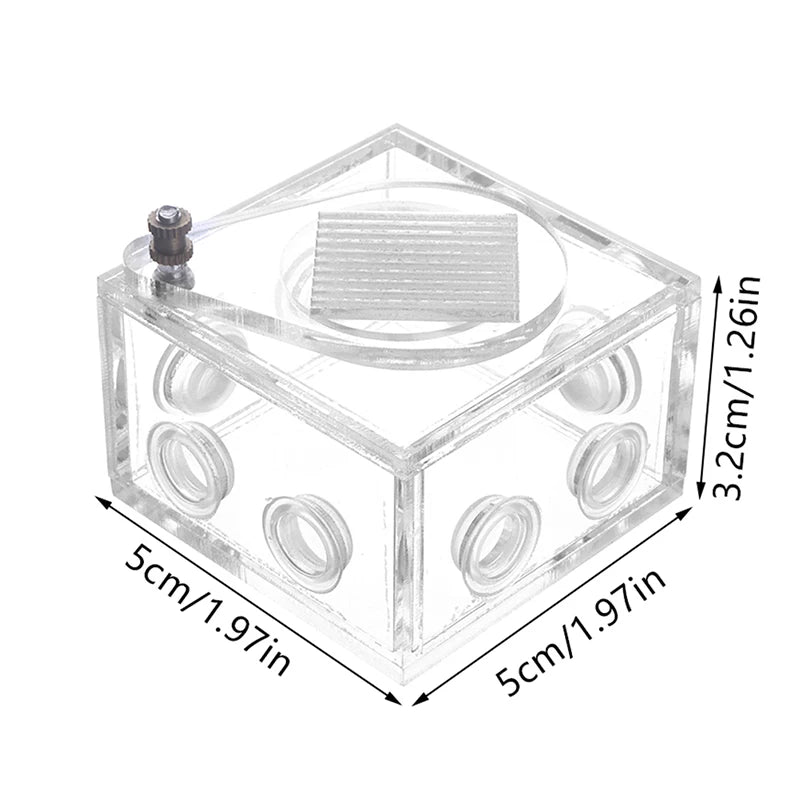
Zero-disturbance observation
Crystal-clear acrylic walls let you track foraging, waste zones, and food caching without lifting a lid or stressing the colony.
Free Worldwide Shipping on Orders over 30$*


Ma boutique
Couldn't load pickup availability
Your founding queen is sealed in her test tube, workers are starting to hatch, and the colony needs somewhere to go. This acrylic ant activity area with test tube connection gives them exactly that: a clear, modular outworld that clips straight onto a standard test tube nest and lets you watch every move without disturbing a single ant.
The test tube setup is the backbone of ant keeping for a reason: it is cheap, it works, and queens love the dark humid chamber at the sealed end. The problem is that once workers start foraging, they need space to move, cache food, and dump waste. Without an outworld, they pile everything into the tube and the whole setup turns into a mess fast. I learned that the hard way with my first Lasius niger (the common black garden ant, a perfect beginner species) colony.
This acrylic activity area solves that in the simplest way possible. The caliber-matched opening connects directly to a standard test tube, so the ants move between nest and outworld on their own schedule. The transparent walls mean you see everything: foraging trails, food caching, waste management. At 5.5 x 3.2 cm it is compact enough for a founding colony of 20-50 workers, yet big enough that the space does not feel cramped. No silicone, no tools, no guesswork.
We stock this alongside our full range of modular formicariums and ant nests because it fills a gap that bigger setups cannot: the transition phase, when your colony has outgrown a bare tube but is not yet ready for a full formicarium. Think of it as the bridge that keeps your setup clean and your ants stress-free during those first critical weeks.
Crystal-clear acrylic walls let you track foraging, waste zones, and food caching without lifting a lid or stressing the colony.
The caliber-matched port fits standard test tube nests with no adapters, so ants move freely between nest and outworld the moment you connect them.
At 5.5 x 3.2 cm, this outworld is sized for colonies of 20-80 workers: large enough to keep the tube clean, small enough that ants do not feel exposed.
The same connection standard lets you daisy-chain multiple activity areas or swap in a larger DIY ant farm feeding box as worker numbers climb.
| Dimensions | 5.5 x 3.2 cm (allow 1-3 mm manufacturing tolerance) | |
| Material | High-clarity acrylic (PMMA), no high-concern chemicals | |
| Color | Fully transparent | |
| Origin | Mainland China | |
| Box contents | 1 x acrylic activity area unit | |
| Compatibility | Standard caliber test tube nests; DIY ant farm setups |
You caught your first queen during nuptial flight season, she is sealed in a test tube, and workers are starting to appear. You need somewhere for them to forage without turning the tube into a waste dump. This activity area is exactly that first step: simple, transparent, and sized for the founding phase. It also works well for experienced keepers running multiple small colonies of Lasius or Formica species who want a cheap, replaceable outworld for each setup.
Not the right fit if your colony already has 200-plus workers or if you keep larger species like Camponotus (carpenter ants). Those colonies need a bigger outworld with more vertical space. Check our full range of ant formicariums for larger setups.