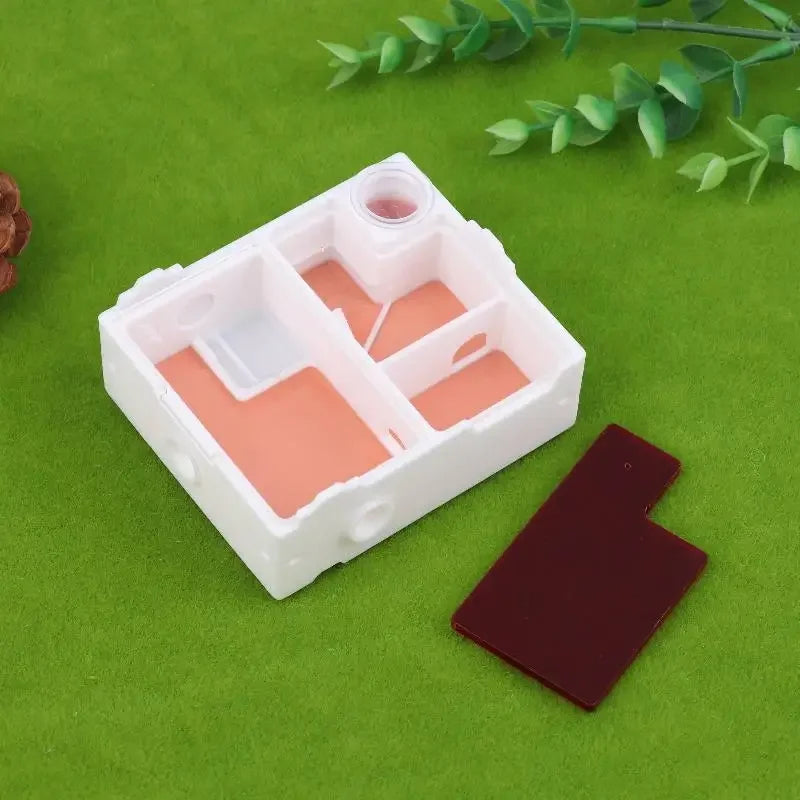
Flat ant farm visibility that actually teaches
The translucent walls give you a full side-on view of tunneling and brood sorting, so you understand colony behavior instead of just guessing at it.
Free Worldwide Shipping on Orders over 30$*


Ma boutique
Couldn't load pickup availability
Your first flat ant farm starter kit should show you exactly what is happening inside the colony, without guessing, without drilling holes in expensive acrylic, and without spending more than a cup of coffee. This compact nest does that.
I bought my first observation nest at a flea market when I was fourteen. It was a plastic sandwich box with some dirt and a piece of tape over the lid. The queen escaped on day two. That experience taught me the single most important thing about beginner ant-keeping gear: the enclosure has to be purpose-built, not improvised. This flat ant farm is exactly that kind of purpose-built starting point.
The design separates the dry nesting chamber from a small humid zone, which mirrors how small species like Lasius niger (the common black garden ant) and Lasius flavus (the yellow meadow ant) naturally partition their underground galleries. The translucent plastic walls let you watch tunneling, brood care, and foraging without disturbing the colony. At 8.5 x 7 x 3.2 cm, it is sized for a founding queen and her first 20-50 workers, which is precisely the stage most beginners are at when they catch their first queen during summer nuptial flights.
The materials are non-toxic plastic and resin, with no chemical treatments that could harm a small colony. It ships flat and assembles in a few minutes, no tools needed. Think of it as the training wheels of ant-keeping: honest, functional, and cheap enough that if you decide the hobby is not for you, you have lost almost nothing.
The translucent walls give you a full side-on view of tunneling and brood sorting, so you understand colony behavior instead of just guessing at it.
A built-in humidity gradient lets ants self-regulate moisture, which reduces mold risk and keeps a founding queen comfortable during the critical early weeks.
At 8.5 x 7 x 3.2 cm, the chamber is right-sized for Lasius and Formica founding colonies, so workers do not get lost in oversized space before the colony grows.
No chemical coatings, no sharp edges: safe for curious hands and for the ants themselves, which matters when you are keeping a living colony at a desk or in a classroom.
| Dimensions | 8.5 x 7 x 3.2 cm (3.35 x 2.76 x 1.26 in) | |
| Material | Plastic and resin, non-toxic | |
| Humidity design | Dry-wet separated chambers | |
| Best-fit species | Small native species: Lasius, Formica, Tapinoma | |
| Box contents | 1 x flat ant farm (ships disassembled, no tools required) | |
| Chemical safety | No high-concern chemicals |
You caught your first queen during a summer nuptial flight, or you just ordered one from a reputable local breeder, and now you need somewhere to put her that will not cost more than the hobby itself. This kit is for you. It is also a solid pick for parents who want a low-risk, genuinely educational setup for a curious kid, and for teachers who want a live colony observation tool that fits on a desk.
Not the right fit if you already have a colony of 200-plus workers, or if you are keeping a larger species like Camponotus pennsylvanicus (the black carpenter ant). Those colonies need significantly more space from the start. For bigger setups, check out our full formicarium collection.