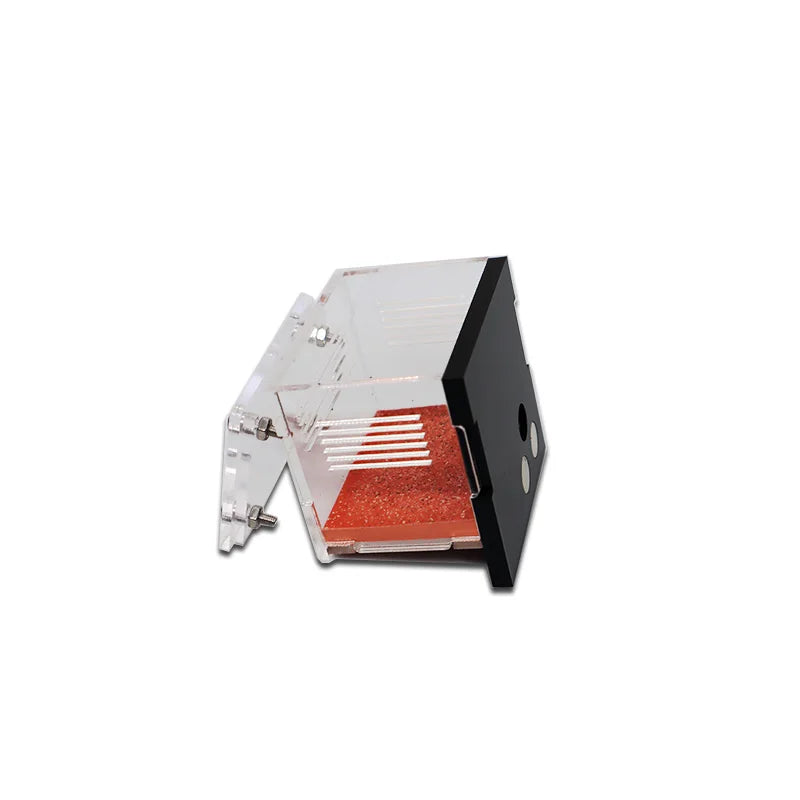
Your colony deserves a home that actually works: this concrete ant farm with external water tower and garbage area gives your ants two stratified nest chambers, a built-in humidity system, and a dedicated waste zone, all packed into a 15 x 11.5 x 9 cm footprint that fits on any desk or shelf.
No harmful chemicals
Ready to populate
2707 units in stock
Most beginner ant farms fail at one thing: humidity. The nest dries out, the queen stops laying, and you spend weeks wondering what went wrong. This setup fixes that problem at the design level. The nest substrate combines gypsum concrete and yellow clay, two materials that absorb and release moisture slowly, the same way natural soil does underground. You are not fighting the environment; the environment works for you.
The external 18 ml water tower connects directly to the nest zone through a 10 mm caliber port. A side-mounted water-level observation window tells you exactly when to refill, no guesswork, no flooding. The magnetic glass cover on the nest area lifts off cleanly for maintenance without disturbing the colony. I ran a small Lasius niger (the common black garden ant, one of the best beginner species) founding setup in a similar concrete nest last spring, and the queen started her first brood within two weeks. The substrate held humidity for four days between refills, which is genuinely impressive for a nest this compact.
The garbage area, sold as an optional magnetic add-on, is not a gimmick. Ants are fastidious. They will designate a waste zone whether you give them one or not, and if that zone is inside the nest, cleaning becomes a real chore. Having a dedicated external chamber keeps the nest substrate clean and extends the time between full teardowns significantly.
Why this concrete ant farm outperforms basic acrylic setups
Concrete ant farm humidity that holds
Gypsum-concrete substrate buffers moisture for days, so your queen keeps laying even if you miss a refill by 24 hours.
Two-chamber nest layout for growing colonies
Stratified upper and lower chambers let workers separate brood from food stores, which mirrors how ants organize underground naturally.
Magnetic cover for escape-proof observation
The acrylic glass lid snaps shut with magnets, giving you a clear view of tunnel activity without any gap that workers could exploit.
Modular water tower ant farm design scales with you
Three expansion ports let you connect outworld arenas or additional nest modules as your colony grows past the founding stage.
Concrete ant farm with water tower: full specifications
Overall size
15 x 11.5 x 9 cm
Active foraging area
11.5 x 7.5 x 9 cm
Nest chamber area
11.5 x 7.5 x 4.5 cm
Material
Acrylic, glass, gypsum concrete, yellow clay
Harmful chemicals
None
Water tower capacity
18 ml
Expansion ports
3 ports, 10 mm caliber each
External garbage area
4 x 6 x 5 cm (magnetic, optional add-on)
Nest stratification
2 levels
How to set up and maintain your concrete ant farm correctly
Before adding any ants, fill the water tower to the halfway mark and wait 30-60 minutes. The concrete substrate will absorb moisture and reach a stable humidity level before your colony moves in.
Check the water level window every 2-4 days. Refill through the side injection port using a small syringe or pipette. Never pour water directly onto the substrate surface.
Clean the garbage area weekly by detaching the magnetic module and rinsing it with warm water. No soap needed; residue can irritate the colony.
Keep the farm away from direct sunlight and heat sources. Most beginner-friendly species, like Lasius niger (black garden ant) or Formica (wood ant), thrive at 22-26 C (72-79 F) during the active season.
Use the three 10 mm expansion ports to connect a foraging outworld or a second nest module when your colony outgrows the founding chamber. Standard ant-keeping tubing fits the caliber directly.
If you are keeping a species that hibernates, like Lasius niger, move the entire setup to a cool location (4-10 C / 39-50 F) from November through February. The concrete substrate handles temperature swings better than plain plaster.
Who this concrete ant farm with water tower is built for
This nest is the right call if you caught your first queen this summer and want a setup that handles humidity automatically, or if you are a parent looking for an educational formicarium that a 10-year-old can actually maintain without daily supervision. The water tower and level window remove the single biggest beginner mistake: letting the nest dry out.
It also works well for intermediate keepers running a small Messor barbarus (the seed-harvesting ant, a popular species for watching granary behavior) or a compact Camponotus (carpenter ant) founding colony. The two-chamber layout gives workers enough spatial variety to organize naturally.
Not the right fit if your colony already numbers in the thousands, or if you keep army ants or other species that need very large foraging territories. For those situations, a larger modular system would serve you better.
Concrete ant farm with water tower: questions buyers ask before ordering
What ant species fit this nest size, and how many workers can it support?
The nest chamber (11.5 x 7.5 x 4.5 cm) comfortably houses a founding queen through a colony of roughly 50-200 small-to-medium workers. Species like Lasius niger, Formica fusca, and small Messor barbarus (seed-harvesting ant) colonies are ideal. Larger species such as Camponotus pennsylvanicus (the black carpenter ant, common across the US) can start here but will need an expansion module connected via the 10 mm ports within 6-12 months of active growth.
How long does shipping take, and does the concrete substrate survive transit?
Shipping times vary by destination; check the estimated delivery window at checkout for your specific region. The concrete and acrylic construction is significantly more impact-resistant than plain plaster nests, which are notorious for cracking in transit. The nest ships disassembled with the magnetic modules packed separately, which reduces stress on the substrate during handling.
Will the concrete substrate stay mold-free over time?
Mold is a real concern in any humid nest, but the gypsum-concrete mix used here resists it better than pure plaster because concrete is denser and less porous. The key is not overfilling the water tower: keep it at 50-70% capacity rather than topping it off completely. If you spot surface mold in the foraging area, remove it with a dry cotton swab and reduce your refill frequency slightly. The external garbage area also helps by keeping organic waste out of the main nest, which is where mold typically starts.
What is the difference between the full kit and the magnetic add-on variants?
The base "Ant farm" variant ($158.95) includes the complete nest with both chambers, the built-in water tower, the magnetic glass cover, and all three expansion ports. The "Magnetic water tower" ($42.95) and "Magnetic garbage area" ($43.95) are sold separately for keepers who already own a compatible nest and want to upgrade it, or who want a spare module. If you are starting from scratch, the full kit is the only option you need.