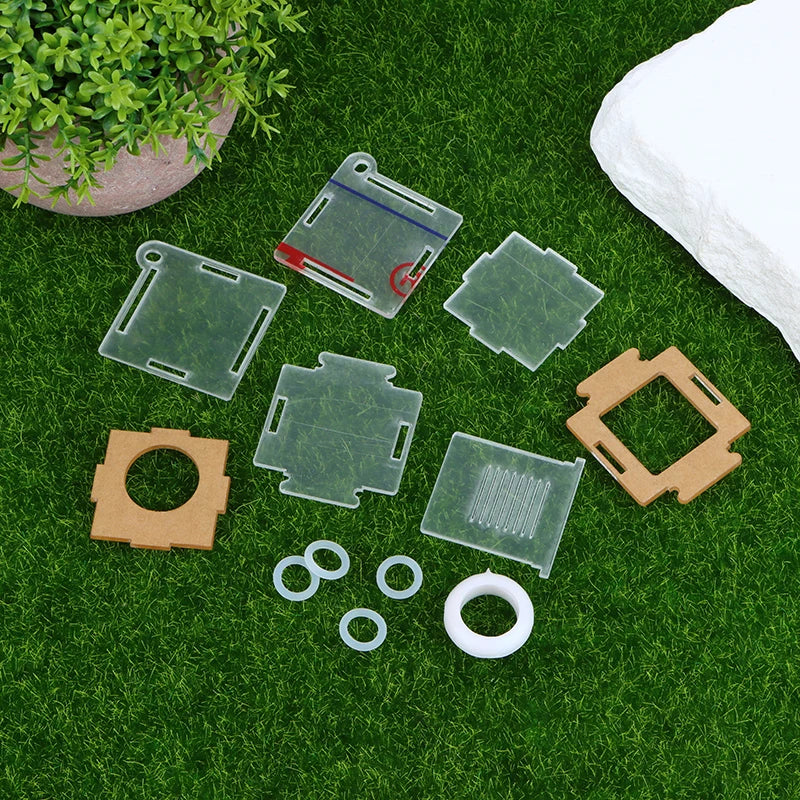
Optical clarity that lasts
High-transparency acrylic stays crystal-clear through daily condensation cycles and worker traffic, so you never miss a brood-care moment.
Free Worldwide Shipping on Orders over 30$*


Ma boutique
Couldn't load pickup availability
Your founding queen is sitting in a test tube right now, and she deserves a setup that actually lets you watch her. The acrylic ant farm test tube nest connects directly to a standard 15 mm or 18 mm tube, giving your colony a crystal-clear activity area the moment workers start exploring.
Most beginners start a colony in a test tube, which is exactly right. The problem comes a few weeks later: the queen has laid eggs, the first workers are hatching, and you are pressing your face against a glass tube trying to see anything. That is the moment this nest was designed for. It screws or press-fits onto a standard 15 mm or 18 mm test tube and opens up a flat, 7 x 7 cm foraging chamber made from optically clear acrylic, so you can finally see what is happening without disturbing the brood.
I ran a founding setup like this for a Lasius niger colony (black garden ants, one of the best beginner species in North America) for about three months before moving them to a larger formicarium. The clarity held up perfectly: no fogging, no scratching from the workers, no warping near the heat mat. The acrylic is confirmed free of high-concern chemicals, which matters when your colony is living inside it around the clock.
At $12.95 for the 15 mm version and $14.95 for the 18 mm, this is one of the lowest-friction upgrades you can make to a test-tube founding setup. It does one thing and does it well: it gives your ants room to move and gives you a clear view of every stage of early colony growth.
High-transparency acrylic stays crystal-clear through daily condensation cycles and worker traffic, so you never miss a brood-care moment.
Two caliber options mean the activity area connects snugly to the most common founding tube sizes, with no adapter needed and no gap for escapees.
Small enough not to overwhelm a young colony of 10-50 workers, large enough to watch foraging trails and food-sharing behavior develop in real time.
Confirmed free of high-concern chemicals, so you can house your ant farm test tube nest setup indefinitely without worrying about off-gassing near your queen or brood.
| Activity area footprint | Approx. 7 x 7 cm (2.75 x 2.75 in) | |
| Tube caliber (choose one) | 15 mm or 18 mm inner diameter | |
| Primary material | High-transparency acrylic (PMMA) | |
| Color / finish | Fully transparent, no tint | |
| Chemical safety | No high-concern chemicals detected | |
| Package contents | 1 complete nest set (activity area + tube connector) | |
| Price | $12.95 (15 mm) / $14.95 (18 mm) |
This nest fits you if you caught your first queen during nuptial flight season, she is already in a test tube, and you want to watch the founding process without constantly disturbing her. It also works well for parents setting up a first educational ant colony with kids: the flat transparent chamber makes brood development visible and genuinely exciting to follow. Experienced keepers running multiple test-tube founding setups in parallel will appreciate the low cost per unit.
Not the right fit if your colony already has 200-plus workers and needs a full-size formicarium with separate nest and outworld chambers. At that stage, check the larger formicarium options instead.