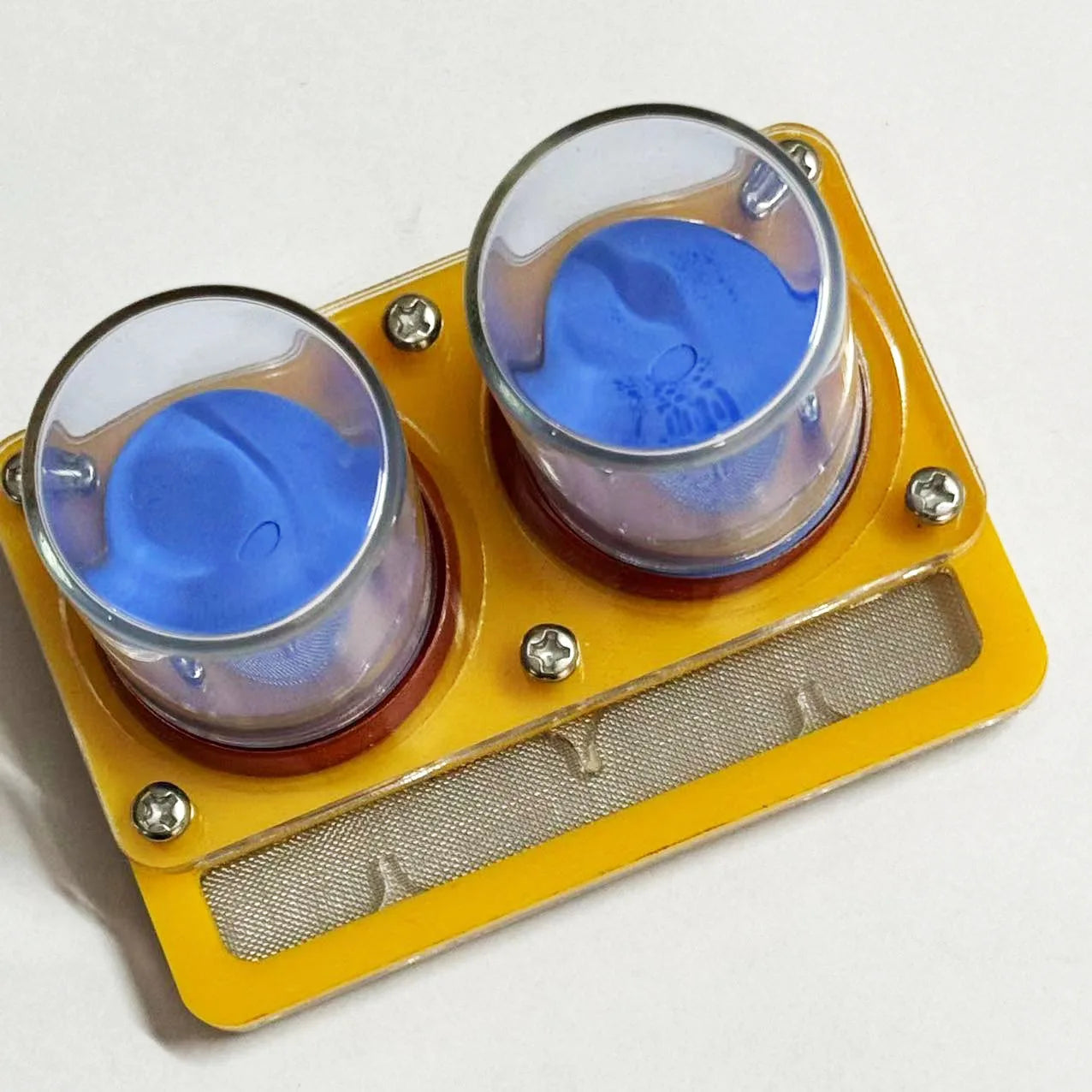
Passive hydration for ant farm acrylic nests
Capillary action delivers moisture at the substrate's own pace, so humidity stays in the 60-80% range your colony needs without any manual intervention between refills.
Free Worldwide Shipping on Orders over 30$*


Ma boutique
Couldn't load pickup availability
Dry soil kills colonies faster than any predator. The dual tower ant farm water feeder keeps your nest at the right moisture level around the clock, without daily refills or soggy substrate disasters.
I learned the hard way that a cotton ball stuffed into a test tube is not a hydration system. It works for a founding queen, sure. But the moment your Lasius niger (the common black garden ant) colony moves into a proper formicarium, that improvised wick becomes a liability: you either forget to check it, or you oversaturate and trigger a mold outbreak. I lost a promising Camponotus pennsylvanicus (the big black carpenter ant) colony to exactly that mistake in my second year of keeping.
The dual tower design solves this with a passive capillary system. Water migrates from the reservoir through the porous base at the rate the substrate actually demands, not the rate you remember to add it. The two-tower format means one side can serve as the main hydration source while the other acts as a buffer, giving you a visual read on consumption without opening the nest. The clear acrylic walls let you watch the water level drop in real time, which is genuinely useful data about your colony's activity.
At $19.95 for the 30 ml version and $28.95 for the 70 ml, this sits in the range where it costs less than one bad substrate replacement. It connects to standard 9 mm ant-keeping tubing, so it slots into most modular setups without adapters. Yes, you will end up watching the water level like it is a stock ticker. We all do.
Capillary action delivers moisture at the substrate's own pace, so humidity stays in the 60-80% range your colony needs without any manual intervention between refills.
The 70 ml tower holds enough for a mid-size colony over several days, cutting your maintenance routine from daily checks to a comfortable twice-a-week refill schedule.
Standard-diameter ports connect directly to the tubing you already own, so adding this feeder to an existing acrylic formicarium setup takes under two minutes.
Watch the water level drop through transparent walls and learn your colony's actual hydration rhythm, which is far more useful than any humidity gauge for beginners.
| Available heights | H 4 cm (30 ml), H 6 cm (50 ml), H 8 cm (70 ml) | |
| Material | Clear acrylic (PMMA), food-contact safe | |
| Colors | White, Green | |
| Reservoir capacity | 30 ml / 50 ml / 70 ml depending on size selected | |
| What is in the box | 1 dual tower water feeder unit (towers pre-assembled) | |
| Compatibility | Standard 9 mm ant-keeping tubing; fits most modular acrylic and plaster formicariums | |
| Price entry point | From $19.95 (30 ml) to $28.95 (70 ml) |
This feeder fits keepers who run one or more acrylic or plaster formicariums and want to stop babysitting moisture levels every day. It works especially well for Lasius niger, Formica species, and Messor barbarus (the seed-harvesting ant common in southern Europe and the US hobby scene), all of which thrive at moderate, stable humidity. Parents setting up a first educational colony for kids will find the visible water level genuinely useful as a teaching tool. If you are running a founding queen in a single test tube, you do not need this yet. Come back when the colony moves into its first proper nest. Check out our full range of ant-keeping accessories when you are ready to build out a complete setup.
The 30 ml H 4 cm version covers small colonies up to roughly 200 workers and fits compact formicariums where space is tight. The 50 ml H 6 cm is the most versatile pick for mid-size colonies of 200 to 800 workers. Go with the 70 ml H 8 cm if your colony is large and active, or if you travel and need several days of autonomy between refills. When in doubt, size up: a larger reservoir never hurts, and you can always leave it partially filled.
Standard international shipping typically runs 10 to 20 business days depending on your location. A tracking number is provided once your order ships, so you can follow the parcel through your account. If your order has not moved in 25 business days, contact support directly with your order number and we will sort it out.
Acrylic (PMMA) is stable at the temperatures ant colonies require, typically 18 to 28 degrees Celsius for most temperate and subtropical species. It will not crack from normal use. The main risk is UV exposure: prolonged direct sunlight yellows clear acrylic within months. Keep the feeder in ambient indoor light and it stays clear for years. Avoid acetone-based cleaners, which etch the surface.
Cotton wicks and sponges work for founding tubes but have two real problems at colony scale: they dry out unpredictably and they trap bacteria when oversaturated. The dual tower feeder uses a porous ceramic or sintered base that releases water at a controlled rate, which means no sudden dry spells and far less mold risk. You also get a visible reservoir, so you know exactly when to refill instead of guessing. For a complete beginner ant farm kit, pairing this feeder with a plaster or acrylic nest is the setup I would recommend from day one.