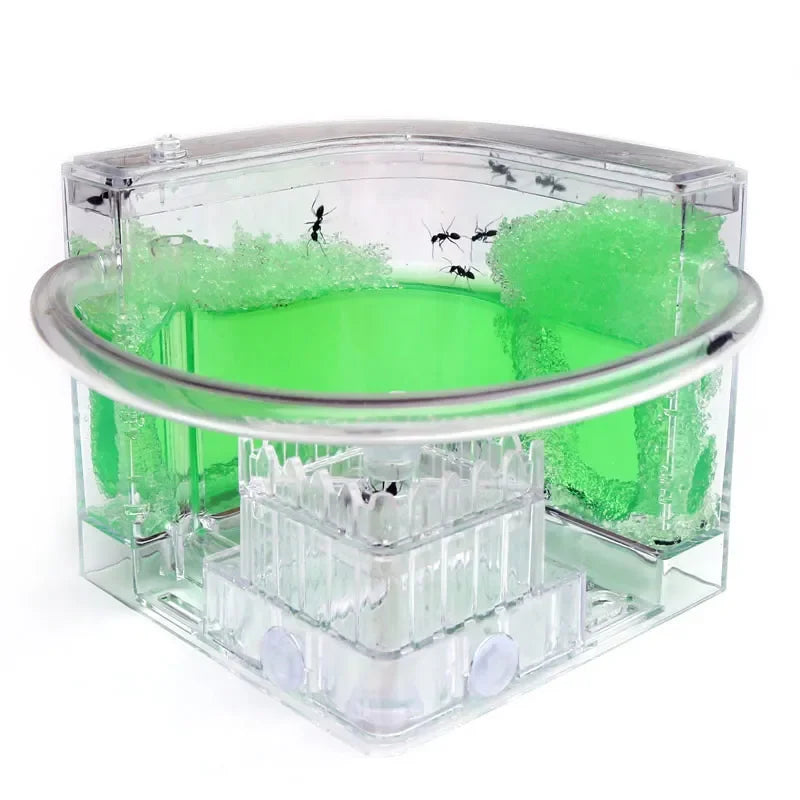
Multi-level sand nest tunneling room
Stacked roller-coaster chambers give workers 3-4 distinct digging zones, so a colony of 30-200 workers stays active and visible for months without outgrowing the space.
Free Worldwide Shipping on Orders over 30$*


Ma boutique
Couldn't load pickup availability
Your first ant farm sand nest should do more than just hold dirt. This roller-coaster-style ecology habitat gives a founding colony real tunneling depth, visible foraging lanes, and a layout that makes every excavation session worth watching.
Sand nests have been a staple of the hobby for decades, but most budget versions share the same flaw: the tunneling space is too shallow, so a colony of even 50 workers fills it in a few weeks and you are back to square one. I ran into that problem myself with a flat acrylic starter nest during my first Lasius niger (the common black garden ant) colony. The ants excavated every accessible channel in under two weeks, then started piling sand against the lid. Not ideal.
This estate-style habitat takes a different approach. The roller-coaster chamber layout stacks multiple foraging corridors at different heights, which gives workers genuine choices about where to dig and where to store food. The colored plastic shell (available in blue, green, or yellow) also doubles as a light diffuser, keeping the inner chambers dim enough that a queen will actually settle in rather than constantly trying to escape toward brighter corners. That single design detail matters more than most product listings will tell you.
At $45.95 it sits in the sweet spot for a first or second nest: substantial enough to house a founding colony through its first growth phase, affordable enough that you are not devastated if you make a setup mistake. Pair it with a water-tube moisture system and a thin layer of moistened sand, and you have a functional habitat ready in about 15 minutes.
Stacked roller-coaster chambers give workers 3-4 distinct digging zones, so a colony of 30-200 workers stays active and visible for months without outgrowing the space.
The tinted plastic shell filters ambient light so the queen reads the nest as dark and safe, which dramatically reduces escape attempts and stress-related brood abandonment.
Proportioned for Lasius niger, Formica, and small Camponotus founding colonies: roomy enough to grow into, compact enough to maintain humidity without constant misting.
No tools, no mixing compounds: fill with slightly moistened sand, add a water tube, place your queen tube at the entrance, and the colony does the rest.
| Material | Durable plastic (BPA-free shell, sand substrate not included) | |
| Color options | Blue, Green, Yellow (same price, same dimensions) | |
| Origin | Manufactured in Mainland China | |
| What is in the box | 1 x ecology sand nest habitat (sand and ants not included) | |
| Recommended colony size | Founding stage up to approx. 200 workers | |
| Price | $45.95 (all color variants) |
This nest is a strong fit if you are in your first or second year of ant keeping, you have a founding queen (or a small colony of under 100 workers), and you want something that looks good on a desk without requiring a dedicated enclosure cabinet. Parents setting up an educational habitat for kids aged 8 and up will find the visible tunneling genuinely engaging, and the colored shell makes it easy to spot activity at a glance.
It is probably not the right call if you are already running a mature Camponotus (carpenter ant) colony of 500-plus workers or if you keep species that need very precise humidity gradients, like Messor barbarus (the seed-harvesting ant). Those colonies need larger, more modular setups. For everyone else starting out: this is a solid, honest first habitat.