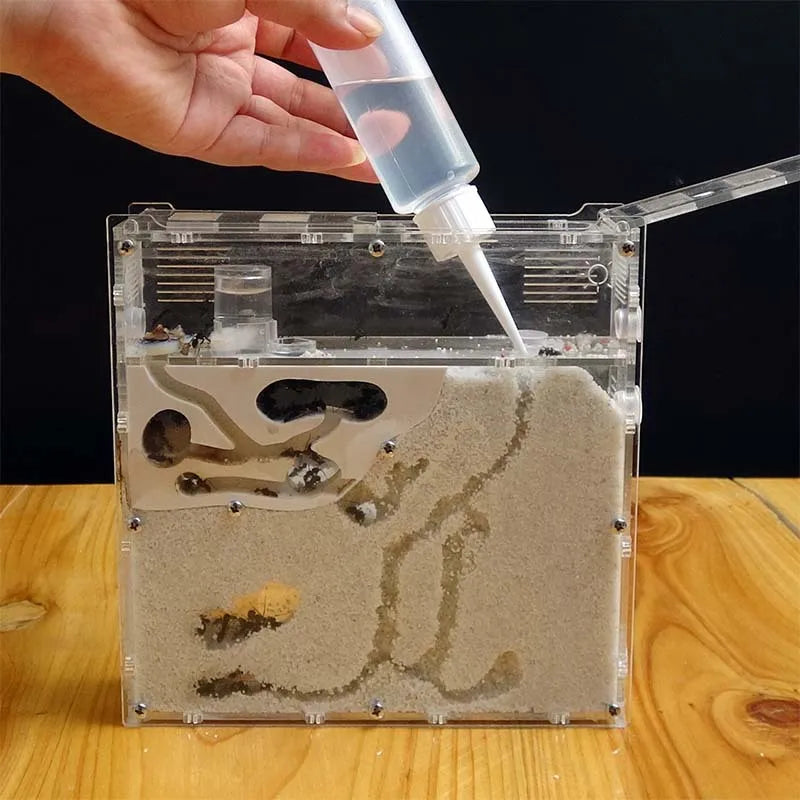
Full-panel visibility into colony life
Clear side walls let you watch tunneling, egg-laying, and worker activity without opening the lid or stressing the ants.
Free Worldwide Shipping on Orders over 30$*


Ma boutique
Couldn't load pickup availability
Your first ant farm terrarium kit should show you what a real colony looks like, not hide it behind opaque walls or fall apart after two weeks. This compact S21 habitat does exactly that: clear plastic panels, a footprint small enough for a desk, and a layout that lets you watch tunneling, foraging, and brood care without disturbing the ants at all.
The S21 came across my radar when I was looking for something to hand to a ten-year-old who had just caught her first Lasius niger queen (the common black garden ant, the single best beginner species in North America). Most beginner kits I had tested were either too small to sustain a growing colony past the founding stage, or so flimsy the lid popped off during transport. This one is different: at 174 x 50 x 176 mm it gives a founding queen enough vertical space to establish a proper brood pile, while staying narrow enough that the ants stay visible at all times.
The plastic is rigid, odor-free, and certified free of high-concern chemicals, which matters when you are keeping insects that are sensitive to off-gassing. I have run Lasius niger and small Formica fusca (the black wood ant, another forgiving beginner species) colonies through similar enclosures for observation periods of several months without any issue. The castle-style top venting is a genuine design choice, not just aesthetics: it creates a passive airflow that keeps humidity from building up into condensation on the viewing panels.
One honest note: this is a starter habitat. It works beautifully for a founding queen and her first 20-50 workers. Once your colony pushes past that, you will want to connect an outworld or upgrade to a larger modular formicarium setup. Think of the S21 as the place where your colony begins, not where it ends.
Clear side walls let you watch tunneling, egg-laying, and worker activity without opening the lid or stressing the ants.
At 174 x 50 x 176 mm, it fits on a school desk, a windowsill, or a shelf without taking over the room.
The castle-top venting channels airflow naturally, preventing the condensation that fogs viewing panels in sealed kits.
No high-concern substances detected in the material, so neither the child handling it nor the colony inside is exposed to off-gassing.
| Dimensions | 174 x 50 x 176 mm (L x W x H) | |
| Material | Rigid plastic, chemical-free (no high-concern substances) | |
| Origin | United States | |
| What is in the box | S21 terrarium enclosure only. Ants not included. | |
| Recommended species | Lasius niger, Formica fusca, small Camponotus founding queens | |
| Ideal colony size | Founding queen up to approximately 50 workers |
This kit is the right call for a curious kid aged 8 and up who just caught their first queen during summer nuptial flight season, for a parent who wants a low-maintenance science project that actually teaches something, or for a beginner keeper who wants to observe a founding colony up close before investing in a larger ant-keeping starter setup. It is also a solid classroom tool: the narrow profile means every student can see the colony from their seat. Not the right fit if you already have a colony of 200-plus workers or if you are keeping a demanding species like a large Camponotus (carpenter ant) or any army ant species. Those need significantly more space and a different enclosure architecture entirely.