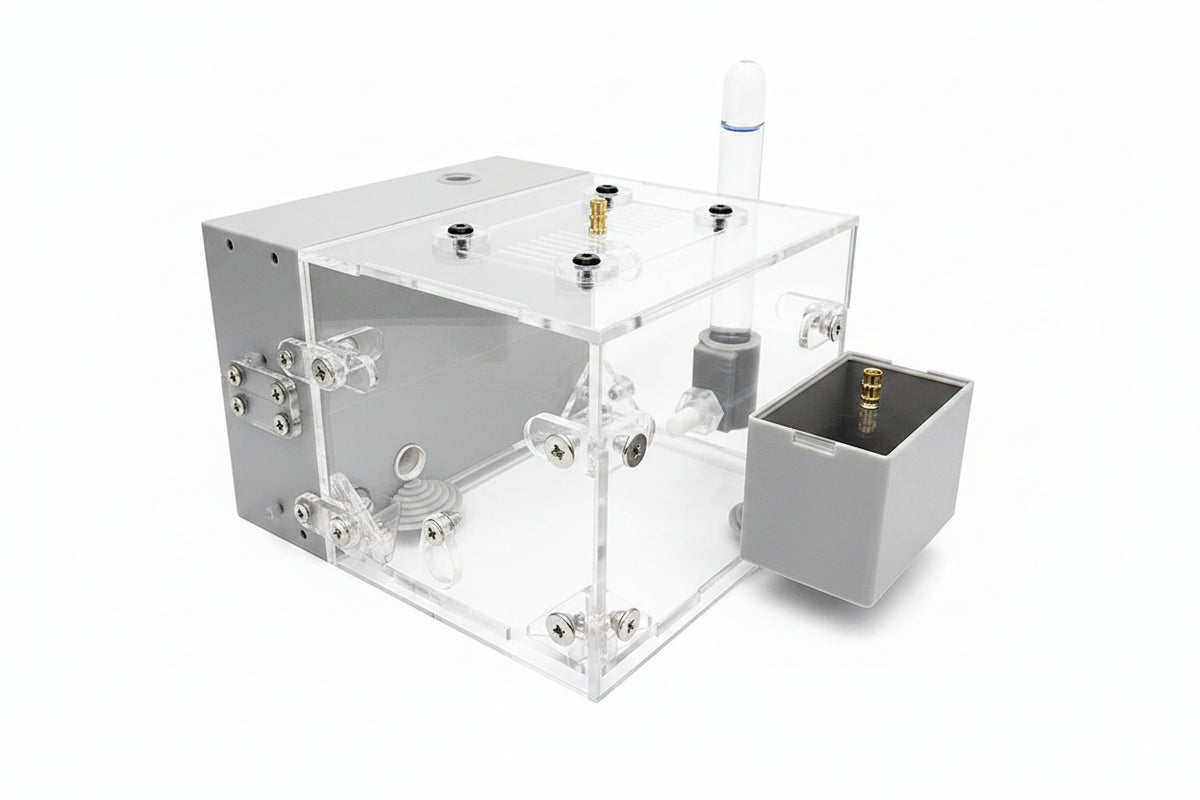
Valley contours that mimic real underground nests
The canyon-shaped chambers give workers natural depth cues, so brood sorting and waste management happen faster than in a flat nest.
Free Worldwide Shipping on Orders over 30$*


Ma boutique
Couldn't load pickup availability
Your ants deserve a nest that mirrors how they actually live underground. The Valley ant farm by AntsKeeper is a 3D-printed PETG formicarium shaped after real canyon topography, built for species from tiny Lasius niger (black garden ants) all the way up to mid-size Myrmecocystus (honeypot ants) and beyond.
The Valley series started with a simple frustration: most flat acrylic nests look nothing like what ants actually build. Andrew, AntsKeeper's founder, spent years watching colonies excavate chambers along natural contours, always following the path of least resistance through soil layers. He translated that observation into a 3D-printed canyon profile, where each chamber sits at a slightly different depth and the corridors curve the way real tunnels do.
The material choice matters here. PETG (glycol-modified polyethylene terephthalate) is the same food-contact-grade plastic used in water bottles. It holds humidity better than standard PLA, resists warping at room temperature, and contains no plasticizers that could harm your colony. The red acrylic light-blocking panel included with every unit lets you observe nocturnal behavior without stressing the ants, since most species treat red wavelengths as darkness.
I run a Camponotus pennsylvanicus (black carpenter ant) colony in one of the acrylic nests we stock, and the first time I watched workers rearrange brood along the valley contours rather than piling it in a corner, I understood why the design works. The topography gives them choices. Ants with choices are ants that thrive.
The canyon-shaped chambers give workers natural depth cues, so brood sorting and waste management happen faster than in a flat nest.
Attach an Upper Unit vertically or expand the foraging area sideways: buy one Lower Unit now, add capacity later without replacing the whole setup.
No off-gassing, no plasticizer leaching: RoHS-certified PETG keeps your colony healthy for years, not months.
The included red acrylic sheet blocks visible light from the nest side, so you can watch without triggering alarm pheromones or disrupting the colony's day cycle.
| Weight | 270 g per unit | |
| Main material | 3D-printed PETG (glycol-modified PET, food-contact grade) | |
| Light blocking | Red acrylic panel (included) | |
| Safety certification | RoHS compliant, no high-concern chemicals | |
| What's in the box | Nest unit, red light-blocking sheet, installation accessories | |
| Colony capacity (small ants, e.g. Lasius) | Up to 3,000+ workers | |
| Colony capacity (mid-size, e.g. Myrmecocystus) | Up to 1,000+ workers | |
| Colony capacity (large ants, e.g. Camponotus) | Up to 600 workers | |
| Assembly required | Yes - difficulty 1-2 out of 5 (beginner-friendly) | |
| Humidity method | Passive air moisture (no water tube required for basic unit) |
The Valley series fits keepers who are past the test-tube founding stage and ready to give their colony a permanent home. You might have a young Lasius niger (black garden ant) queen that just produced her first 20 workers, or a Myrmecocystus mexicanus (honeypot ant) colony you've been nursing for a season. Either way, you want something that looks good on a desk, handles humidity passively, and can grow with the colony instead of forcing a full migration in six months.
Not the right fit if you're keeping army ants (Eciton species) or large exotic Camponotus that need a much bigger foraging footprint from day one. For those, check our large-colony formicarium options. And if you're still in the founding stage with a single queen, a test tube setup is genuinely the better starting point before you invest in a full nest.
Start with the Valley-Basic ($50.95) if you want a complete, ready-to-run setup without extras. Upgrade to Valley-Pro ($64.95) if you want the built-in water feeder and removable waste zone included from day one. Buy a standalone Lower Unit or Upper Unit ($19.95 each) only if you already own a Valley nest and need to expand it. The Lower Unit adds horizontal foraging space; the Upper Unit stacks vertically above your existing chamber.
The nest ships flat-packed and requires light assembly (rated 1-2 out of 5 difficulty). All installation accessories and the red light-blocking panel are included in the box. Shipping times depend on your location and the carrier selected at checkout. For US orders, check the estimated delivery window shown on the cart page before you confirm.
PETG has a heat deflection point well above typical ant-keeping temperatures (most keepers run 24-28 C / 75-82 F for warm-season species). At those ranges, the material stays rigid and does not release plasticizers. The RoHS certification confirms no restricted substances are present. Avoid placing a heat mat directly against the PETG wall; use a side or under-tank mat with a thermostat instead.
A flat acrylic nest gives ants one uniform depth across the whole chamber, so workers tend to pile brood randomly rather than sorting it by temperature gradient. The Valley's 3D-printed canyon profile creates natural high and low points, which ants use the same way they use soil layers underground. The result is faster brood organization and more visible, natural behavior. You also get modular expansion built in, which most flat acrylics do not offer. For a side-by-side look at nest types, see our formicarium types comparison guide.