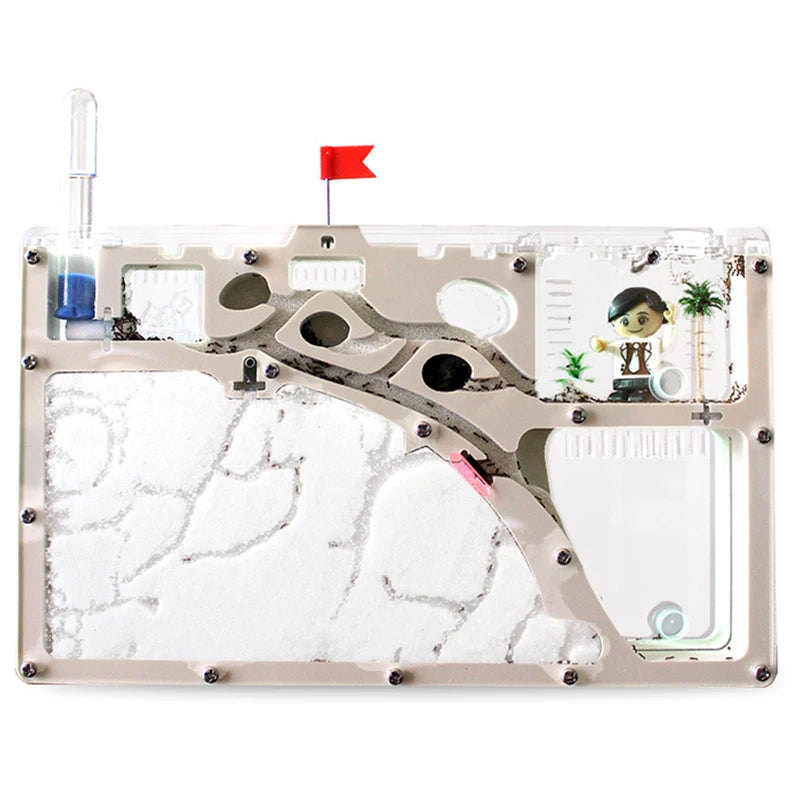
Six zones, real colony behavior
Water supply, feeding, breeding, rest, sand storage, and work areas give your colony the spatial cues they need to self-organize within hours of moving in.
Free Worldwide Shipping on Orders over 30$*


Ma boutique
Couldn't load pickup availability
Your ants need a home that actually works. The ant castle sand farm kit gives a small colony six distinct functional zones inside a compact glass enclosure, so you can watch real tunnel-building behavior from day one, not just ants pacing a featureless box.
I have kept ants in everything from repurposed Tupperware to high-end acrylic formicariums, and the single biggest mistake beginners make is starting with a space that has no structure. Ants in a plain box spend their energy escaping or piling in one corner. Give them zones, and they immediately self-organize: workers haul sand, nurses cluster around brood, foragers patrol the feeding chamber. That behavioral shift happens within hours, and it is genuinely one of the most satisfying things to watch in this hobby.
This glass ant castle is sized for small to medium species, the ones most beginners actually start with: Lasius niger (the common black garden ant), Formica fusca, or a young Messor barbarus colony (Messor, the seed-harvesting ants). At 24 cm long by 15 cm tall and just 4.5 cm wide, it sits on a desk without dominating it, and the narrow depth means the ants tunnel right against the glass so you see everything. The white sand substrate that ships with it is inert and fine-grained, close to what these species encounter in nature.
One thing worth saying clearly: this kit does not include live ants, and that is the right call. Shipping live insects across borders is regulated in most countries, and you should source your colony locally or from a licensed domestic breeder. If you are in the US, check your state regulations before acquiring any non-native species. The gear is ready; the colony is your call.
Water supply, feeding, breeding, rest, sand storage, and work areas give your colony the spatial cues they need to self-organize within hours of moving in.
The 4.5 cm narrow depth pushes tunnels right against the glass panel, so every excavation pass is visible without disturbing the colony.
At 24 x 15 x 4.5 cm, this educational ant farm with sand fits a nightstand, a school desk, or a shelf without needing a dedicated stand or extra space.
The box ships with the glass nest, white sand substrate, a small plant for the leisure zone, and the basic tools, so setup takes minutes, not a hardware-store trip.
| Dimensions | 24 cm L x 15 cm H x 4.5 cm W (approx. 9.4 x 5.9 x 1.8 in) | |
| Main material | Glass (no high-concern chemicals) | |
| Habitat zones | 6 (water, feeding, breeding, leisure, sand storage, work) + communication tunnels | |
| Box contents | Glass nest, white sand substrate, small decorative plant, setup tools | |
| Suitable species | Small to medium ants (Lasius niger, Formica fusca, young Messor barbarus colonies) | |
| Live ants included | No. Source locally or from a licensed domestic breeder. |
This kit fits three types of keepers well. First, the curious beginner who just caught their first Lasius niger queen during summer nuptial flight season and wants a proper home that does not require a biology degree to set up. Second, parents looking for a hands-on science project that holds a kid's attention longer than a weekend, because watching a colony build tunnels over weeks teaches patience and observation in a way no screen can. Third, the hobbyist who wants a secondary display nest alongside a larger acrylic formicarium for a smaller satellite colony or a founding queen.
Not the right fit if you are keeping a mature Camponotus (carpenter ant) colony of 500 or more workers, or any army ant species. Those need significantly more volume and a very different setup. Check our large formicarium collection if that is where you are headed.