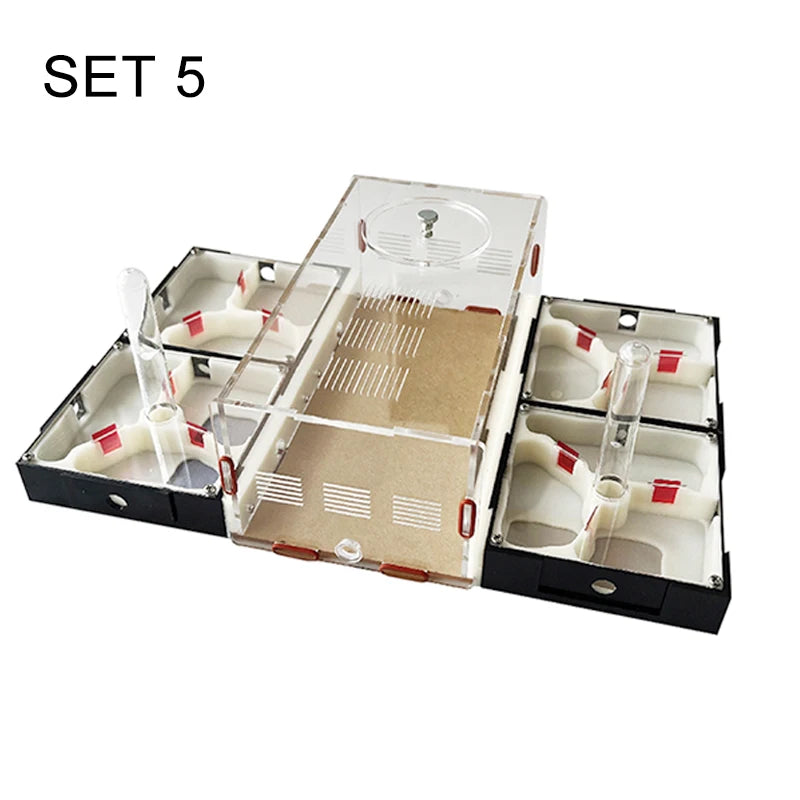
Your colony outgrows its first nest faster than you expect. This modular acrylic ant farm with gypsum nest and water tower is built for exactly that moment: snap on another chamber, refill the tower, and your ants keep moving without a forced migration.
No harmful chemicals
Unlimited expansion
Gypsum + acrylic build
I've run a lot of founding setups over the years, and the single biggest frustration is always the same: you buy a fixed-size nest, your Lasius niger (the common black garden ant, a perfect beginner species) colony hits 200 workers, and suddenly you're scrambling for a new home. The modular connector system on this farm fixes that problem at the root. You add chambers when the colony needs them, not when a crisis forces your hand.
The nest chambers are cast from gypsum, the same material used in lab-grade formicariums. Gypsum absorbs and releases moisture slowly, which keeps the microclimate stable without constant intervention. The integrated water tower feeds the gypsum passively: fill it once every few days and the nest stays in the 50-70% relative humidity range that most common species prefer. The acrylic panels are clear on one side and fitted with a red shading plate on the other. Ants are blind to red light, so you can observe without stressing the colony.
The feeding area is separate from the nest, which matters more than it sounds. Keeping food debris away from the brood chamber reduces mold risk and makes cleanup straightforward. It's a small design choice that shows someone actually kept ants before drawing the blueprints.
Why a modular gypsum ant farm outperforms fixed-size nests
Acrylic ant farm that grows with your colony
Snap on extra chambers at any stage: no forced migrations, no colony stress, no buying a new setup every season.
Gypsum nest keeps humidity stable for your ants
The porous gypsum walls buffer moisture naturally: fill the water tower every few days and the nest stays in the right range without a hygrometer check every hour.
Red shading plate for stress-free ant observation
Ants cannot perceive red wavelengths, so the shading plate lets you watch tunneling and brood care without triggering a defensive response from the colony.
Separate feeding area keeps the nest clean longer
Food stays out of the brood chamber, which cuts mold risk and means you spend less time cleaning and more time watching your colony work.
Acrylic ant farm with gypsum nest: full specifications
Small feeding area
10 x 12 x 9 cm
Large feeding area
12 x 20 x 9 cm
Nest chamber area
10 x 10 cm per module
Primary materials
Gypsum, acrylic, plastic connectors
Expansion type
Unlimited modular (connect as many chambers as needed)
Harmful chemicals
None
Package contents
1 x ant farm set (configuration varies by set chosen)
Setting up and maintaining your modular ant farm correctly
Before introducing any ants, fill the water tower and let the gypsum absorb moisture for at least 24 hours. Dry gypsum stresses a founding queen immediately.
Keep the setup away from direct sunlight and heat sources. Gypsum holds temperature well, but a warm spot near a window will dry it out faster than the tower can compensate.
Clean the feeding area every 2-3 days. Remove uneaten protein (insects, egg) before it molds. Sugar water or honey diluted 1:5 with water stays fresh longer than solid sugars.
Add a new nest module only when the current one is at roughly 60-70% worker capacity. Connecting too early gives the colony more space than it can defend and regulate, which slows brood development.
If you keep a hibernating species like Lasius niger, disconnect and store the nest modules separately in a cool location (4-10 C / 39-50 F) during winter. The gypsum survives hibernation conditions without cracking as long as it isn't frozen.
Who this expandable gypsum ant farm is actually built for
This setup works best for keepers who already have a founding queen or a small colony of 20-150 workers and want a home that won't need replacing in six months. It's a strong fit for beginner-to-intermediate ant keepers running common species like Lasius niger (black garden ant), Formica fusca (black wood ant), or Messor barbarus (the seed-harvesting ant that loves a dry feeding area). Parents buying a first serious setup for a curious kid will find the modular design forgiving: you start small, add on as interest grows, and nothing goes to waste.
It's less suited for very large exotic colonies, army ants (genus Eciton or Dorylus), or species that need substrate depths greater than the 10 x 10 cm chamber footprint. If you're running a mature Camponotus (carpenter ant) colony of 1,000+ workers, look at our full formicarium collection for larger-format options.
Modular acrylic ant farm: questions buyers ask before ordering
Which set size should I choose for a founding queen or small starter colony?
Set 1 (from $59.95) is the right starting point for a single queen or a colony under 50 workers. It gives enough nest space without overwhelming a small group that needs to feel secure in a tight chamber. Sets 2-5 add more modules and feeding capacity, so choose those if you're transferring an established colony of 100+ workers or want room to grow without ordering again soon. You can always check our ant farm starter kits for a side-by-side comparison of what each set includes.
How long does shipping take, and is tracking included?
Shipping times and carrier options are shown at checkout based on your location. All orders include a tracking number sent by email once the package ships. If you're ordering internationally, delivery windows vary by destination country, so check the estimated dates at checkout before confirming. Gypsum components are packed with protective foam to prevent breakage in transit.
Will the gypsum crack or degrade over time with regular watering?
Gypsum used in formicariums is designed for repeated wet-dry cycles. Under normal use (filling the water tower every 2-4 days, never submerging the chamber), the material stays solid for years. The main risk is freezing: if you store the nest during hibernation, keep it above 0 C / 32 F. Hairline surface marks can appear after 12-18 months of heavy use, but they don't affect structural integrity or humidity performance.
How does this compare to a plain acrylic nest or a sand ant farm?
A plain acrylic nest has no moisture-buffering capacity, so you're managing humidity manually with a wet cotton plug or external misting, which is less stable. Sand farms look great but are hard to clean and can harbor mold in the feeding area. This hybrid design gives you the visibility of acrylic panels, the passive humidity control of gypsum, and a separate feeding zone that keeps the nest sanitary. For most common species, that combination beats either alternative on day-to-day ease of maintenance. Browse our acrylic ant nest range if you want to compare formats directly.