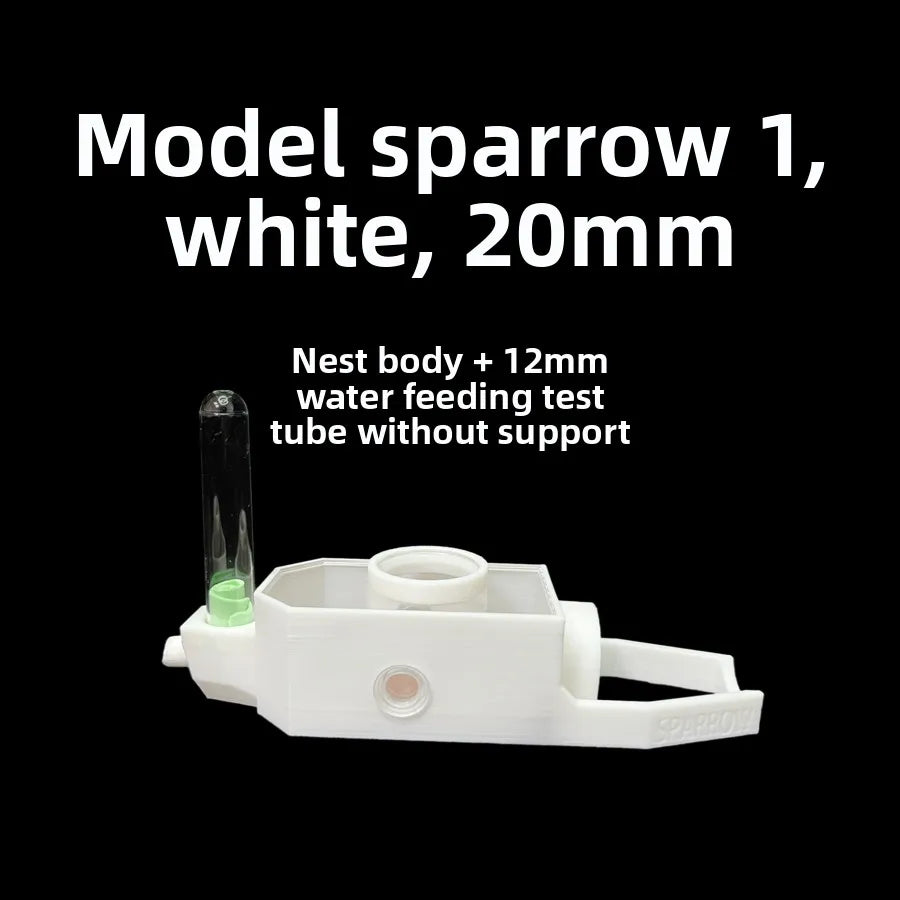
Your queen just sealed herself in a test tube, and you are already wondering what comes next. The Sparrow 1 3D printed ant nest is the answer: a compact castle-style formicarium sized for 18 mm and 20 mm test tubes, built for founding queens and small colonies that are ready to move into their first real home.
400 units in stock
Ships within 2 business days
Packed for safe transit
The Sparrow 1 came out of a frustration I know well. You have a healthy founding queen, maybe a Lasius niger (the common black garden ant, one of the best beginner species out there) or a small Formica group, and every nest on the market is either too large for a micro-colony or too plain to hold humidity properly. The castle design is not just aesthetic: the layered chamber architecture keeps moisture gradients stable across the nest without you having to babysit a cotton plug every other day.
The 3D printed plastic body is rigid enough to stack accessories on top, yet light enough to reposition without disturbing the colony. The single test tube port accepts both 18 mm and 20 mm tubes, which covers the two most common founding setups sold in the hobby. Variant A, C, and E sit at $114.95; variants B and D come in at $111.95, so you can pick the configuration that fits your current setup without overpaying for features you do not need yet.
I ran my own Camponotus pennsylvanicus (the big black carpenter ant, a North American native) founding group through a similar castle-format nest last spring. The colony moved in within 48 hours, which is about as fast as I have ever seen a hesitant queen commit to a new chamber. That kind of quick acceptance tells you the internal dimensions and darkness level are dialed in right.
Why the Sparrow 1 3D printed ant nest outperforms a plain test tube rack
Castle chambers sized for founding colonies
The layered interior gives a queen and her first 20-50 workers distinct brood, rest, and food zones without the wasted space that stresses a micro-colony.
18 mm and 20 mm test tube compatibility
One port fits both standard tube sizes, so you connect your existing founding setup directly without adapters or improvised plugs.
Upgrade path built in from day one
When the colony outgrows the Sparrow 1, the modular port system lets you connect a larger outworld or extension nest without relocating the queen.
Stable humidity without daily intervention
The enclosed plastic structure retains moisture far longer than an open test tube rack, cutting your maintenance checks from daily to every few days.
Sparrow 1 3D printed ant nest: full specifications and materials
Test tube compatibility
18 mm and 20 mm diameter
Main material
Rigid plastic (3D printed)
Design format
Castle / multi-chamber single nest
Variants available
A, B, C, D, E (see selector above)
Colony stage target
Founding queen to small group (up to ~100 workers)
Regulated chemicals
None
How to set up and care for your Sparrow 1 ant nest formicarium
Before connecting your test tube, rinse the nest interior with plain water and let it air-dry for 30 minutes. This removes any residual print dust that could irritate a new queen.
Slide your 18 mm or 20 mm founding tube directly into the port. No tools needed. Cover the nest with a dark cloth for the first 48-72 hours to encourage the queen to move in on her own schedule.
Humidity maintenance: lightly mist one interior wall every 3-5 days. Avoid flooding the chamber floor. The plastic retains moisture well, so less is more here.
Keep the nest away from direct sunlight and heat sources above 82 F (28 C). Most beginner-friendly species like Lasius niger thrive between 68-77 F (20-25 C) inside the nest.
Clean the exterior with a barely damp cloth. Never use soap, alcohol, or any chemical cleaner near the nest opening. The plastic is durable but the colony inside is sensitive to fumes.
When the colony reaches roughly 80-100 workers, connect an outworld or a larger modular formicarium to the existing port rather than forcing a full nest transfer.
Who the Sparrow 1 3D printed ant nest is actually built for
This nest is for the keeper who just caught their first queen during nuptial flight season, or who ordered a founding queen and wants to give her something better than a bare test tube rack sitting on a shelf. It also suits parents setting up a first educational colony for a curious kid: the castle shape is visually engaging, the setup takes under five minutes, and the enclosed design means no escapees during those early weeks when a colony is still figuring out its boundaries.
It is not the right call if you already have a mature colony of 500 or more workers. At that size, you need a full-scale formicarium with dedicated outworld space. The Sparrow 1 is a founding and early-growth nest, and it does that job very well.
Sparrow 1 ant nest: questions buyers ask before ordering
Which variant should I choose: A, B, C, D, or E?
Variants B and D are priced at $111.95 and variants A, C, and E at $114.95. The letter designations correspond to configuration differences (chamber layout or color, depending on the manufacturer's batch). If you are unsure, variant A is the standard configuration and the safest starting point. Check the product images for each letter to confirm the visual you prefer before adding to cart.
How long does shipping take, and is tracking included?
Orders ship within 2 business days. Delivery times vary by destination: domestic US orders typically arrive in 7-18 business days for standard shipping. A tracking number is provided once your order is dispatched. For international orders, check your local customs regulations, especially if you are ordering alongside live ant colonies from another supplier.
How long will the 3D printed plastic hold up with regular humidity and cleaning?
Rigid 3D printed plastic handles the humidity levels required for ant keeping (40-70% relative humidity inside the nest) without warping when you avoid prolonged submersion or direct heat. With normal care, the structure stays solid for several years of active use. The main wear point is the test tube port: handle it gently during tube swaps and it will last the full life of your founding colony and beyond.
How is the Sparrow 1 different from a standard acrylic or ytong nest?
Acrylic nests offer full visibility but require you to manage humidity externally, since acrylic does not absorb or retain moisture. Ytong (aerated concrete) nests retain humidity naturally but are heavier and harder to reconfigure. The Sparrow 1 sits between the two: lighter than ytong, more enclosed than acrylic, and purpose-sized for the founding stage that both formats often overlook. If you want a full-visibility acrylic setup for a larger colony, that is a separate purchase for a later growth stage.