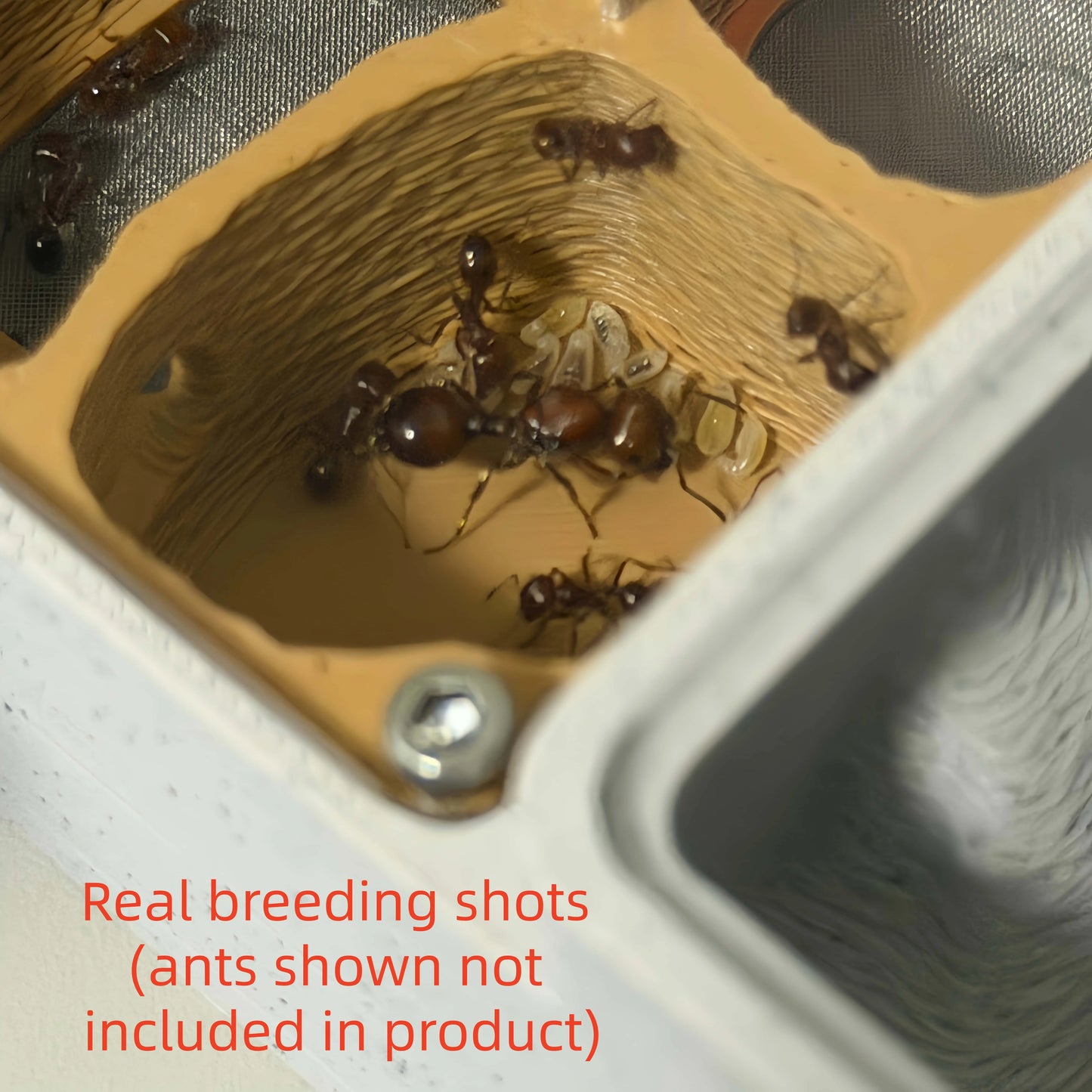
Passive humid water supply that actually holds
The integrated reservoir feeds moisture through the PLA walls steadily, so your founding chamber stays at the 60-70% relative humidity most small ant species need, without daily refills.
Free Worldwide Shipping on Orders over 30$*


Ma boutique
Couldn't load pickup availability
Your first queen just sealed her founding chamber, and the last thing she needs is a nest that dries out overnight. The 3D-printed PLA ant nest keeps humidity exactly where a founding queen wants it, while the clear acrylic lid lets you watch every egg, larva, and pupa without cracking the setup open.
I've killed more founding queens than I care to admit, mostly because I trusted cheap acrylic test-tube setups that turned into tiny deserts within a week. When I switched to a nest that combines a 3D-printed PLA body with a passive humid water supply, my Lasius niger (the common black garden ant, a perfect beginner species) founding success rate jumped noticeably. The PLA walls wick just enough moisture from the reservoir to keep the brood chamber at the right humidity without pooling water that drowns eggs.
The EXOPETO formicarium is built around that same principle. The PLA body is printed at high precision, so the chamber walls are smooth and tight, no rough edges that stress small queens. The transparent acrylic cover sits flush, giving you a clean observation window without light leaks that would send a founding queen into a panic. At 100 x 80 x 38 mm per chamber, it fits small to medium species comfortably: think Lasius, Formica, Temnothorax, or a young Messor barbarus (the seed-harvesting ant common in southern Europe and parts of the US Southwest) colony in its first season.
The detachable layered dividers are the part I wish I had years ago. You start small, one chamber for a new queen and her first brood, then open another section as the colony grows. No need to buy a new nest every six months. That modular logic is exactly how a well-designed ant formicarium should work, and it is rare to find it at this price point.
The integrated reservoir feeds moisture through the PLA walls steadily, so your founding chamber stays at the 60-70% relative humidity most small ant species need, without daily refills.
Detachable dividers let you open one section at a time, matching nest space to colony size so workers never feel lost in an oversized formicarium during the critical founding stage.
The flush-fitting transparent cover gives you a full view of brood development without opening the nest, keeping disturbance near zero during the fragile claustral founding phase.
High-precision PLA carries no chemical off-gassing, so a newly caught queen can be introduced the same day without an acclimatization wait that risks losing her brood.
| Chamber dimensions | 100 x 80 x 38 mm per single nest chamber (1-3 mm manufacturing tolerance) | |
| Body material | High-precision 3D-printed PLA (polylactic acid), non-toxic, odorless | |
| Cover material | Transparent acrylic (PMMA), flush-fitting observation lid | |
| Chamber layout | Multi-compartment with detachable layered dividers, expandable as colony grows | |
| Humidity system | Passive humid water supply integrated into PLA body | |
| Box contents | 1 x complete ant farm nest set (ants not included) | |
| Suitable species | Small to medium ant species: Lasius, Formica, Temnothorax, young Messor colonies |
This formicarium is the right first nest for anyone who just caught their first queen during nuptial flight season and wants a setup that handles humidity automatically, without babysitting a cotton-plug test tube every other day. It also works well for experienced keepers running multiple colonies who need a reliable, low-maintenance founding unit for common species like Lasius niger or Formica fusca.
It is not the right pick if you are keeping large Camponotus (carpenter ant) colonies with hundreds of workers, or exotic species that need very specific microhabitats. For those, check out our large-colony formicarium options with bigger chamber volumes and custom ventilation.