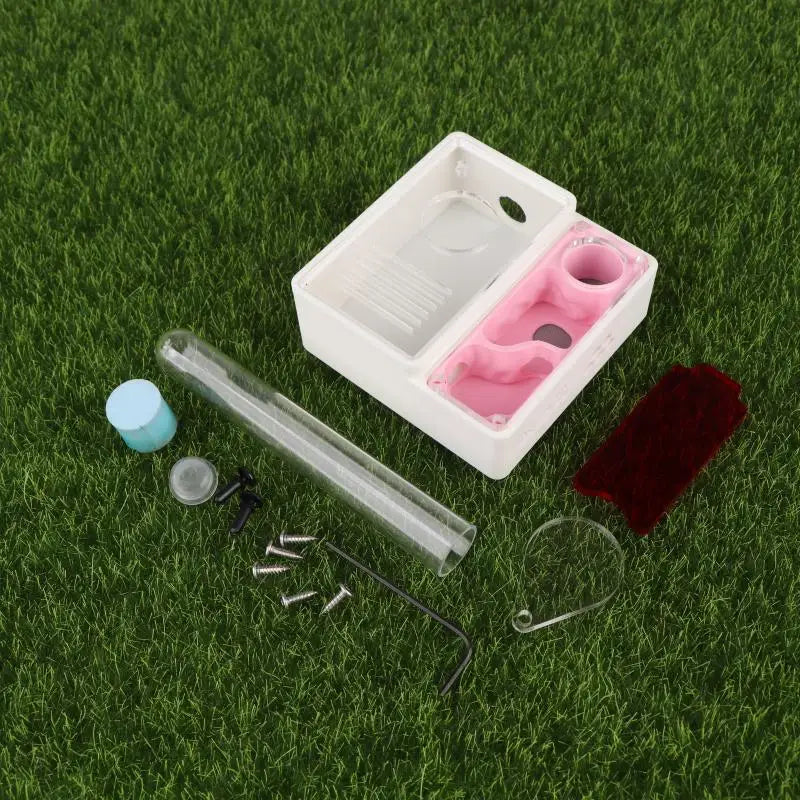
Your first queen ant needs a home that fits her, not one that overwhelms her. This 3D printed ant farm nest for beginners gives a founding queen exactly the right chamber size, the right darkness, and the right material to start laying eggs with confidence.
No harmful chemicals
Ready to use out of the box
Ships in protective packaging
When I set up my first Lasius niger colony (the common black garden ant, and honestly the best beginner species out there), I made the classic mistake: I gave a lone founding queen a formicarium built for a mature colony. She spent two weeks dragging her eggs from corner to corner, stressed, unable to maintain humidity in a space ten times too large for her. The brood suffered. I learned the hard way that founding stage is all about tight, dark, humid chambers.
This nest is printed in PLA, a plant-derived plastic that contains no plasticizers or heavy-metal pigments. At 6.9 x 6.9 x 2.8 cm, the footprint is compact enough to sit inside a test-tube setup or a small outworld without wasting bench space. The chamber geometry is sized for small species: Lasius niger, Lasius flavus (the yellow meadow ant), Tetramorium caespitum (pavement ants), and similarly sized Formica workers all move through the corridors without bottlenecking. Two color variants let you match your existing setup or simply pick whichever you prefer.
PLA prints hold fine surface detail that cast resin or injection-molded plastic often loses at this price point. The tunnel walls have a slight texture that ants grip naturally, which matters more than it sounds when a queen is moving brood at 3 a.m.
Why this 3D printed ant farm nest works better than a test tube alone
Chamber size matched to small ant species
Tight 6.9 cm corridors keep a founding queen's brood cluster together, reducing stress and improving larval survival during the critical first weeks.
PLA material with zero harmful additives
Food-grade PLA contains no plasticizers or heavy-metal pigments, so your colony is not exposed to off-gassing chemicals that can harm brood or queens.
Beginner ant keeper setup in under two minutes
No drilling, no silicone curing time, no waiting: place your queen inside, add a damp cotton plug for humidity, and you are done.
Upgradeable when your ant colony outgrows it
This nest works as a founding chamber you connect to a larger formicarium later, so you are not buying a dead-end product: it becomes part of a growing system.
3D printed beginner ant nest: full specifications and materials
Dimensions
6.9 x 6.9 x 2.8 cm
Material
PLA (polylactic acid, plant-derived)
High-concern chemicals
None
Variants available
Color 01 ($18.95) and Color 02 ($19.95)
Package contents
1 x 3D printed ant nest
Suitable species
Small ants: Lasius niger, Lasius flavus, Tetramorium caespitum, small Formica
How to set up and maintain your beginner ant farm nest correctly
Place the nest in a dark, stable location. Founding queens of Lasius niger and Tetramorium caespitum prefer 22-26 C (72-79 F) and 60-70% relative humidity during the founding stage.
Maintain humidity by placing a small damp cotton plug at the nest entrance or in an adjacent water reservoir. Do not flood the chamber: condensation on the walls is the target, not standing water.
Do not disturb the queen during the first 4-8 weeks. Founding queens of most small species are claustral, meaning they seal themselves in and raise the first workers from fat reserves. Checking too often stresses them.
Clean PLA surfaces with a barely damp cloth only. Avoid alcohol-based cleaners: they can micro-crack the print layer over time and create rough edges that trap debris.
Keep the nest away from direct sunlight. PLA softens above roughly 60 C (140 F), so a windowsill in summer sun is a real risk. A shelf or cabinet works perfectly.
When your colony reaches 30-50 workers, connect the nest to a larger formicarium from our ant habitat collection using standard 9 mm tubing. The founding chamber becomes a satellite brood room.
Who this beginner ant farm nest is actually built for
You caught your first queen during nuptial flight season, or you just ordered one from a reputable local breeder, and now you need a proper home for her before she starts laying. This nest is sized for exactly that moment: the founding stage, before you have workers, before you need a large habitat. It suits beginners who want a clean, safe, low-cost starting point without committing to a full ant keeping starter kit right away. Parents buying a first educational setup for a curious kid will find it approachable and affordable.
Not the right fit if you are keeping larger species like Camponotus pennsylvanicus (the black carpenter ant, which needs wider tunnels) or if your colony already has 100-plus workers and needs a full habitat. For those situations, check out our full-size acrylic formicariums instead.
Beginner ant farm nest: questions buyers ask before ordering
Which ant species fit this nest, and which are too large?
The chamber corridors are sized for small species with workers in the 2-4 mm range. Lasius niger (common black garden ant), Lasius flavus (yellow meadow ant), Tetramorium caespitum (pavement ant), and similarly sized Formica species all move through comfortably. Larger species like Camponotus (carpenter ants, workers up to 13 mm) will find the tunnels too tight and should go into a wider-gauge nest. If you are unsure about your species, measure your queen's body length: anything under 10 mm is generally a good fit here.
How long does shipping take, and does it ship internationally?
Shipping times depend on your location and the carrier selected at checkout. Domestic US orders typically arrive within 7-18 business days for standard shipping from overseas suppliers; check your order confirmation for the tracking link. International shipping is available to most countries, though customs clearance times vary. This product contains no live animals, so there are no USDA or CITES restrictions on the nest itself.
Will PLA crack or warp over time with humidity inside the nest?
PLA is not hygroscopic in the way that some other plastics are, so normal ant-keeping humidity levels (60-70%) will not cause swelling or warping. The main risk is heat: keep the nest below 45 C (113 F) and away from direct sun, and the print will hold its shape for years of normal use. Surface micro-scratches can appear over time if you clean with abrasive tools, but they do not affect structural integrity or ant welfare.
How is this different from a standard test-tube founding setup?
A test tube is the classic founding method and works well, but it gives you zero visibility into brood development and no room to add a water reservoir separately from the queen's chamber. This 3D printed nest gives you defined chambers, visible tunnel layout, and a stable footprint you can place inside an outworld or connect to tubing later. Think of it as the next step up: still minimal and beginner-friendly, but with more structure than a cotton-plugged tube. Both approaches work; this one is easier to observe and expand.