

Moving your ant colony to a new nest without stress
Even in a voluntary move, a full relocation often takes 24 to 72 hours.
A rushed move risks losing workers, brood or the queen.
This article shows you how to move your colony step by step, when a move is worth making, how to prepare the new nest, and what to do if the ants will not go.
How to move ants to a new nest without stressing the colony
In a voluntary move, the workers do most of the work. Scouts start exploring within a few hours, and brood movement often begins within 12 to 24 hours.
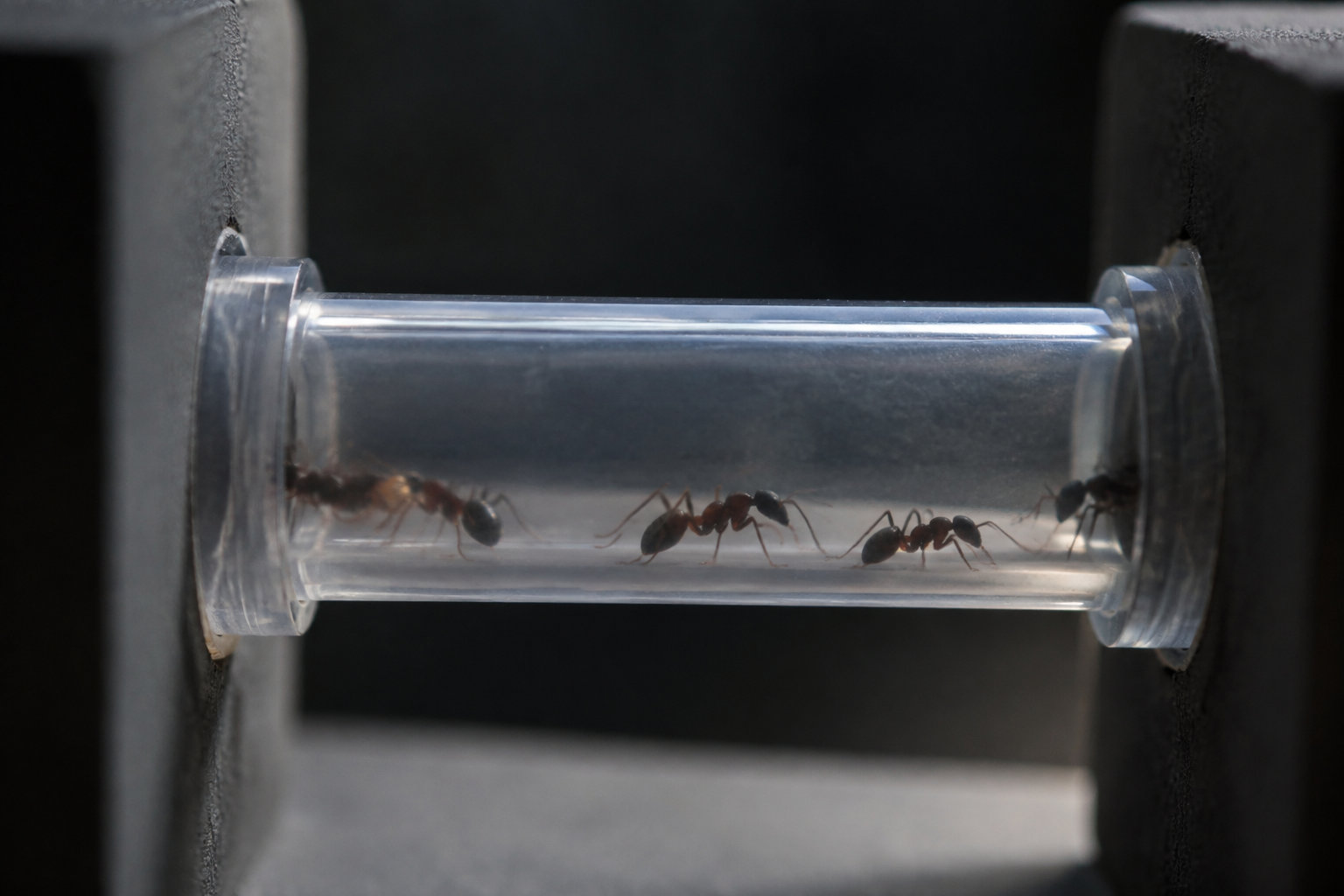
A full move often takes 24 to 72 hours, so plan for days, not minutes.
The order is consistent: workers explore first, then carry the brood, larvae before eggs. The queen moves last, with workers around her. Keep the old tube connected so the ants can choose when to go.
Handle the colony with care
Habits that cause losses
- Shaking or pouring ants into the new nest
- Handling the queen roughly, which can injure her or drop and crush brood
- Disconnecting the old nest as soon as the queen moves, since workers may still return for brood
Habits that keep the colony safe
- Connect the old and new nests, then let the ants choose when to go
- Keep the old nest connected until the last brood and workers have moved
- Check every panel and connector for gaps before connecting anything
- For housing and humidity at each stage, see the Lasius niger care sheet.
Signs that a colony is ready for a larger nest
Worker count alone does not decide the move. For Lasius niger, a crowded test tube and about 30 to 50 workers are signs to consider a move, but species, worker size, brood volume, space, water and waste matter too.
Watch for workers gathering at the tube entrance, a brood pile filling the usable space, or the queen moving eggs toward the entrance. A failing water reservoir, contamination, or care that keeps getting harder are also reasons to move.
A depleted test tube calls for a fresh tube, not a bigger formicarium. Exploring outside the nest alone does not prove the colony needs more space. For tube setup and formicarium timing, start with the beginner’s guide to ant keeping.
Choosing a new nest and preparing it before the transfer
Choose a nest that fits your colony now, with room to grow. A nest that is far too large can leave a small colony exposed. For a nest that expands with your colony, see the Modular Ecological Ant Nest.
Before you connect anything, check every lid joint, mesh edge, port and tube joint. Small workers can escape through openings that look too small to matter. Push each connector fully into place, then test it with a gentle tug.

Hydrate the nest at least 12 hours before the move, so moisture spreads through the material. Keep it damp, not flooded, and keep the nesting area dark. Make sure food and water stay available in the outworld.
Encouraging the colony to relocate on its own
Connect the occupied tube or old nest to the prepared new nest, then wait. Once the connection is open, most colonies move on their own, so the first step is to leave the setup alone.
If the colony needs a push, cover the new nest and uncover the old one.
Ants often choose a dark nest, so the new space becomes more attractive without forcing anything. Keep both setups away from direct sunlight, strong lamps and excess heat.
Do not tap the setup or check it constantly, because vibration and repeated handling disturb the colony. Look in from time to time.
Workers carrying larvae, eggs or pupae mean the brood transfer has started. A move can take hours or days, so do not set a deadline.
What to check when the ants stay in the old nest
If the ants stay in the old nest, check the new one: it must be dark, damp enough for the species, not too large for the colony, and at a suitable temperature. Seal every connection and leave it undisturbed.
If the old nest is still safe, with water and room, the ants simply prefer it for now.
Keep the connection open and give them time. Repeated changes do more harm than waiting. For colonies that refuse to budge, read the transfer guide.
If nothing moves after 6 to 8 hours, check the connection, darkness and moisture first. If the old setup is failing and the colony is small, a fresh test tube is better.
When a faster transfer is needed in an emergency
A faster move is justified only in an emergency. Act promptly if water floods the nest, the structure fails, mold or contamination threatens the colony, or the water supply is no longer usable.
This is different from moving a healthy colony only because a bigger or newer nest is ready. In that case the colony keeps its own pace, and nothing is gained by forcing it.
Before you move a single ant, prepare the safe housing and secure it. Hydrate it, close every opening, and check that it is ready to receive them. Keep the work area dim while you work.
Keep the queen and brood together as much as possible, since they are the first priority.
Keep every handling step short and gentle, and do not shake or tap the nest.
Never use chemicals, carbon dioxide or refrigeration to subdue the ants during a transfer. These methods put the colony at more risk and do not make the move safer.
A voluntary move is slow, so plan for days. Keep the queen and brood together, connect the nests, and leave the setup alone. Move only for a real reason, like a crowded tube or failing water.
Your next step: hydrate and seal the new nest, then connect it and wait.
Frequently asked questions
How do ants start a new colony?
A new colony usually starts when a mated queen, one that has already mated with males, leaves her old colony, finds a nest site and lays eggs. The eggs hatch into larvae, then pupae, then adult workers.
How long does it take ants to settle into a new nest?
Many colonies complete a move in 24 to 72 hours when the new nest is suitable. Small founding colonies can move faster. The ants set the timing, so give them the full window before you judge the move.
Can a queen be moved without harm?
Yes, a queen can move without harm, as long as no one handles her. Connect the nests and let her follow the workers when she is ready. Never tip or shake her out of the old nest.
Should the new nest be dark or lit?
Dark. Keep the new nest dark during the move, since ants tend to settle in the darker space.
A dark new nest is the one the colony is more likely to pick, so the light should stay on the old nest.